Labels

Showing posts with label Skins. Show all posts

Tuesday, 1 July 2014

Crochet

These images are of a coral scene made entirely of crochet by the institute for  figuring in LA. 

Olek a polish crochet artist covers any object in crochet for example this crocodile instillation in Sao Paulo.
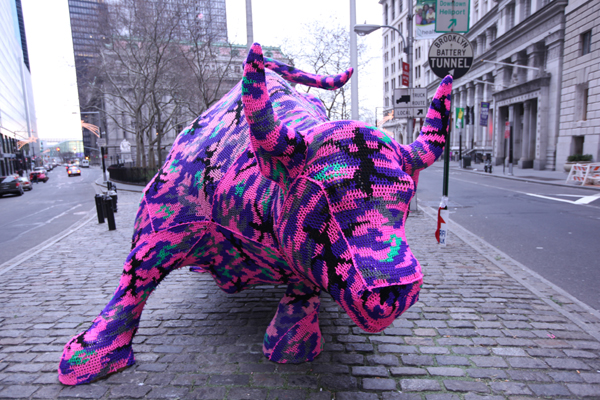
The famous charging bull in New York.
Even people in their habitats.


Lisa Kokin

This is one of lisa's 'the origin of birds'. i like how she has created the cover of the book using patchwork and it doesn't look neat. 


Thursday, 19 June 2014

Sample -

This is my sample of Weave / Peg Loom. I have tried to create something that resembles grass/moss and i thought that the .... would give the sample a 

Jo Hamilton

Jo Hamilton is a textile artist who creates portraits using crochet and they are amazing! I love how Jo leaves the threads to dangle from the crocheted image.

Sample - Applique

This is another sample of applique but from looking at the artist Rosie James. I have looked at a tigers pattern and added different materials to create the pattern and even cut out pieces of paper and sewn round some of the edges, also leaving the loose ends of the threads. If this sample was covered more then i would like it better but i do like this technique.

Sample - Rag Rugging

This is my sample of rag rugging and i dont like this technique as it take a lot of time and to create a decent sized piece that looks good takes a lot of planning.


Sample - Applique

This is my sample of applique although for the smaller pieces of fabric i have used the glue gun to apply them. I have tried to create some bark using similar colours and using the different colour layered up.


Sample - Felting

This is my sample of felting and i have tried to create a feather but it has not come out well. 

Sample - Crochet

This is my sample of crochet.


Sample - Mola work

These are my samples of mola work which i rather enjoyed doing. This first one i have done i have tried to create a zebra pattern. I like how this technique can have as many layers of any type of material, in this sample i have used 4 different types of material and i have also cut straight though all of them which also looks good. Also i have chosen to keep the edges rough rather than sewing round them to neaten them up.

This next one i have tries to create snakes skin and where i have cut all the way though and stuck in my book i have layed it over the fabric that looks like snakes skin and it looks off but works rather well.
With this sample i have used quilted applique on the odd few along with mola work to try and create scales. I dont like this sample as much.


Sample - Quilted applique and free machining

Looking at my research into human cells i decided to create something similar using stitch, the cell i was looking at was the bacterial cells called Staphylococcus aureus.
 By pinching the material on the reverse side and using a simple stitch to sew the material together i created the oval shapes. Once i had turned the material over i realized you could see the stitch and i didn't like it as it looks messy. I then remembered a technique i looked at a few years ago which was quilted applique and thought i could use this technique to create the ovals. After i had successfully attached and stuffed the fabric on i then used the free machine to sew on the lines about the ovals to make the sample look more like the image from my research. Here is the out come.
 I love how it has turned out and also i have left on the loose ends of the threads as they also add to the sample. The reverse side also looks good although by my picture you can not see as good.

Human skin close up

Here are some of the human cells that I have found and like because of their weird shapes

This is an image of an embryonic stystem cell.
This is a neuron and it forms the nervous system. The biggest part of this is the heart known as soma and the branches from this are called dendrites and axons.
This is a close up of a glial cell which is what your brain is made out of. 
This is a close up of the red blood cells.
These are improperly formed white blood cells that dont help the body they attack it 


Tuesday, 17 June 2014

Rosie James

Rosie James is a textile artist who uses applique and stitch using a machine. She creates everyday scenes for example this one of the couples walking down a high street.

I love how Rosie has left on the loose ends of the string that hasn't been sewed onto the fabric. Also I love how detailed her machine stitch work is of the figures, as you can se on this one below.

Here is a hand she has created in detail that looks amazing to say it has been done with a machine.


Skin

Images of Skin.
This is a microscope image of partial loaded with TGF-β.
This is a close up of human skin flakes.

This is an image of  Bacterial cells called Staphylococcus aureus.

Weave&Peg Loom

Weaving involves a warp and a weft thread and the easiest way to remember it is that weft sounds like left therefore the weft is the thread that goes from left to right and the warp is the one up and down. Weaving has become a mass production industry.
A textile impression has been found and indicates that weave has been around the paleolithic era.

A loom holds the warp threads and the weft threads are woven from one end to the other alternating the warp threads with the leavers. There are 3 basic weaves there's plain weave, satin weave and twill. You have the opportunity weave a decorative design which would need to be planned.


A contemporary artist who uses weave is Suki Russack. She creates tapestries of women with a double weave. A double weave is where there are 2 threads on both the warp and the weft that are woven to create an image.

Saturday, 14 June 2014

Wallpaper

As my parents are taking off the wallpaper in the house I stopped them as the way it was hanging from the ceiling looked odd but reminded me of peeling skin so I have taken some photos of them. 
This last one is a pile of the wallpaper on the floor.

Sunday, 1 June 2014

Applique

Applique is where you are adding smaller pieces of material to other materials as decoration or enhancement.

Appliqued cloth has been the tradition in Benin which is in west Africa since the 18th century. A famous piece of applique is the Hastings embroidery which was constructed in 1965 to represent the 900 years of the battle of Hastings in 1066. It consisted of 27 panels that were 9 by 3 ft each and was made by the royal school of needle work.
Applique is also used in quilting, Dresden Plate uses the traditional american quilt blocks which are made up of both applique and patchwork. Here is an image of one of her blocks.

I have managed to find a contemporary artist who has created a piece of applique, here is the image of her work. Unfortunately I haven't been able to find her name but here is her webpage where she has made many textile products and goes on to tell how she has created them. 
This piece she says she has tried to create an underwater plant scene using applique and a sewing machine to sew the piece of scrap material down and to create more detail. I like how she has kept some of the fraying edges.

Saturday, 31 May 2014

Mola Work

What is mola work in textiles?
         Well it is a technique used in textiles where different types of fabric are layered together and pinned in place. Then with tailor's chalk a pattern is drawn on to create a line to sew around. Once the layers of fabric have been sewn together look at the pattern and using scissors cut out the fabric in one section. Once you have gotten to the layer / fabric you like stop cutting and do so with the rest of the pattern. This is also known as reverse applique.
         Mola is part of the traditional dress of a Kuna woman. In their native language 'mola' means 'shirt' or 'clothing'. The technique originated from body paint that was painted on the bodies of the kuna woman in geometric patterns.